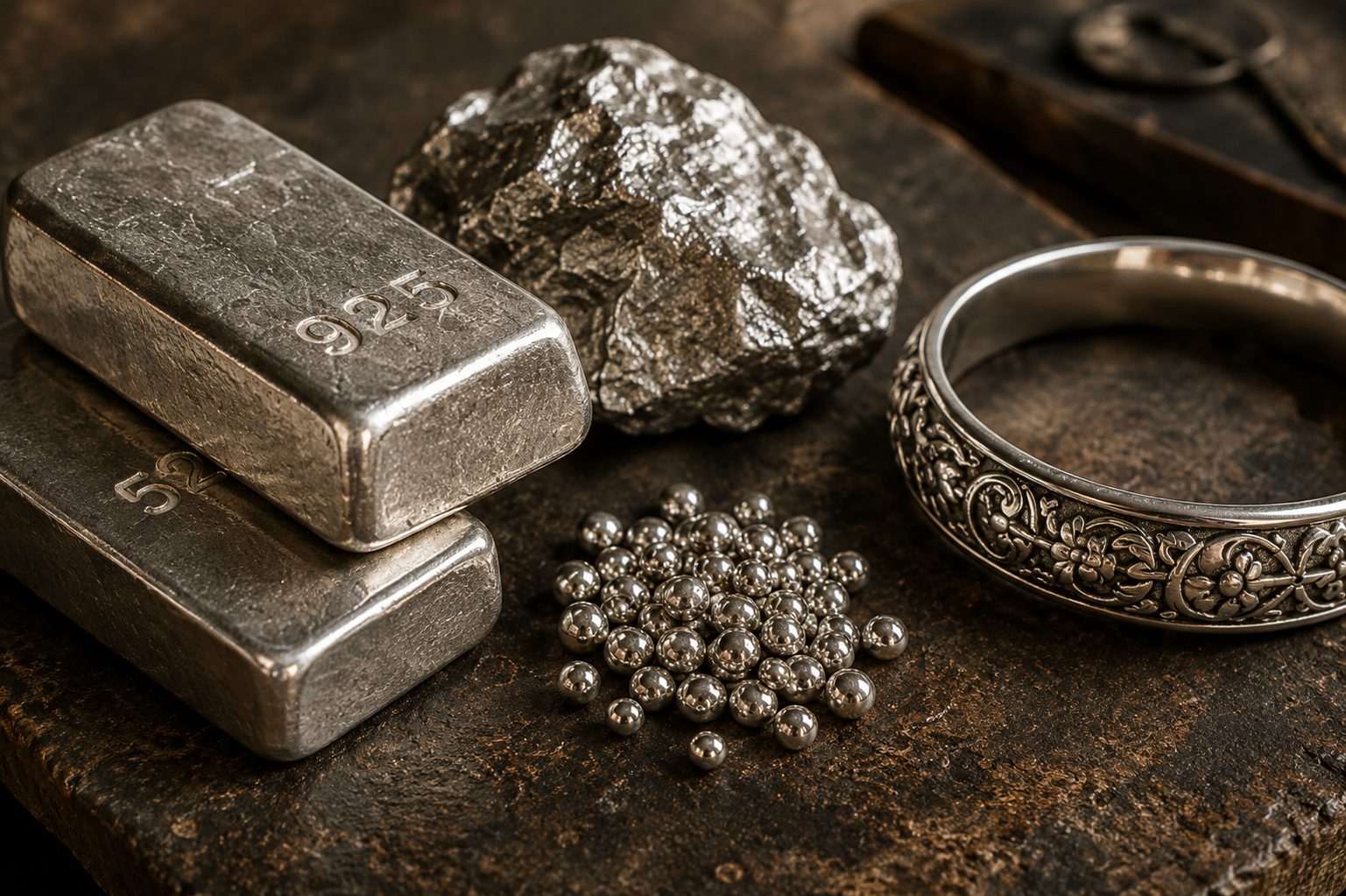
Gold has always announced itself in a royal household. Silver did something quieter, and in Tonk, arguably something more constant. Long before it appeared in a jewellery box, silver moved through the daily life of the court in a hundred practical, intimate forms — the paandan passed around after a meal, the ittar bottle kept at a Begum's bedside, the anklets worn by the women of the house simply because they were comfortable enough for every day, not only for the days that called for gold. Where gold marked an occasion, silver simply lived with you.
That familiarity is precisely what makes it, we think, the truest material for a jeweller's hand. Silver is soft enough to be pushed, in the finest sense of the word — coaxed by a small hammer into the curl of a leaf, drawn into wire fine enough to be woven like thread, engraved with a line as delicate as a calligrapher's — and it forgives an artisan's correction in a way harder metals rarely do. It is why the lattice work, the raised florals and the fine hand-carved texture that define this region's jewellery-making tradition have always felt more at home in silver than in any other metal. And when it is deliberately darkened — oxidised into the shadows of a carved surface — it takes on a depth gold cannot manage: a piece that holds both brilliance and shadow at once.
There is also, we admit, something in the symbolism that keeps drawing us back. In this part of India, silver has long been read as the cooler, calmer cousin of gold — associated with the moon rather than the sun, worn close to the skin rather than kept only for display, offered as a gift at a birth as often as at a wedding. It was, in its way, a more democratic metal: within reach of a household of modest means as much as a Begum's, worn by a farmer's wife and a Nawab's daughter alike, with only the intricacy of the work separating one piece from another.
We find that history difficult to set aside in favour of a flashier metal. Silver is, quite simply, the material this craft was built for — patient enough for an artisan's slowest, most careful hour of work, and humble enough to have always belonged to everyone, not only to a court. Every piece we make is our way of arguing that the humbler metal was, all along, the more honest kind of luxury.