A little over a hundred kilometres separate Tonk from Jaipur — close enough, in the days of the Nawabs, for the two courts to exchange craftsmen, manuscripts and gossip with equal ease; close enough today for a design idea born in Tonk to be sitting on a silversmith's bench in Jaipur before the day is out.
The pairing suits the trade well. Jaipur has spent centuries becoming India's great capital of gem-cutting and jewellery-making — a city of lapidaries who can facet a stone by eye, and karigar families who have specialised, generation after generation, in one particular stage of the work: one house known for its piercing, another for its enamelling, another for setting stones so finely that the metal holding them all but disappears. Tonk, meanwhile, kept the history — the courtly motifs, the mirror-work of the Sunehri Kothi, the manuscript borders and calligraphic curves that still shape how a piece is imagined before it is ever drawn. Between the two cities sits nearly everything a jewellery house needs: heritage on one side of the journey, industry on the other.
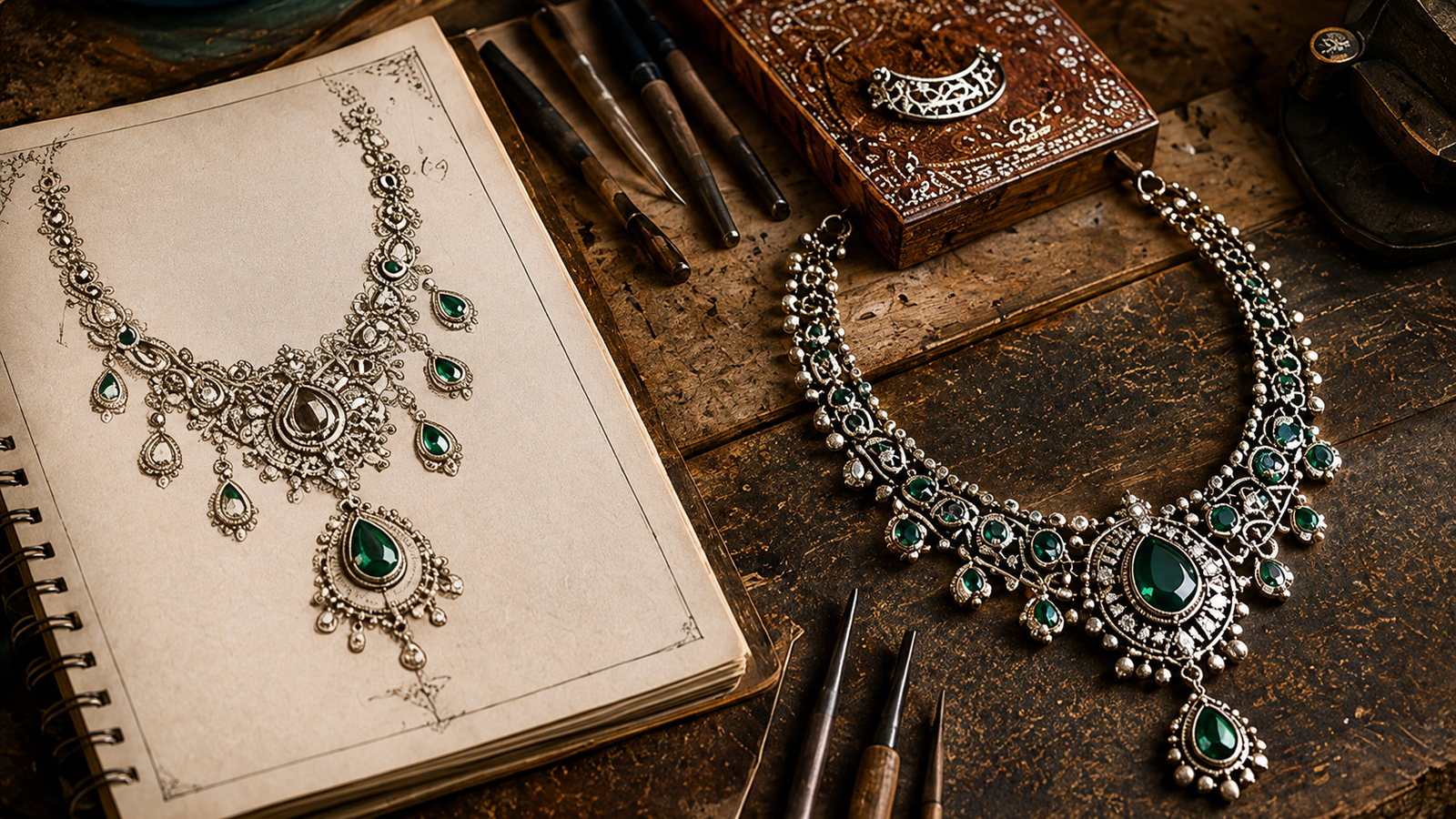
A single design usually makes that journey more than once before it is finished. It begins as a pencil sketch, often referencing some detail of old Tonk architecture or ornament, refined on paper until the proportions feel right. From there it travels to Jaipur, where a wax or metal model is raised by hand, tested against the sketch and adjusted — a curve softened, a setting enlarged to hold a stone properly — before the piece is cast in sterling silver. It then passes through several more sets of hands: one artisan for the piercing and fine metalwork, another for setting each stone, another again for the oxidising and polishing that gives the surface its final depth and shine.
By the time an earring or pendant is finished, it has usually been touched by five or six different pairs of hands, each trained in a single craft perfected over generations, working within a hundred kilometres of where the idea first began. It is a short distance to hold so much history and so much skill — but then, that has always been the particular advantage of this stretch of Rajasthan: a princely past and a working city, near enough to finish each other's sentences.