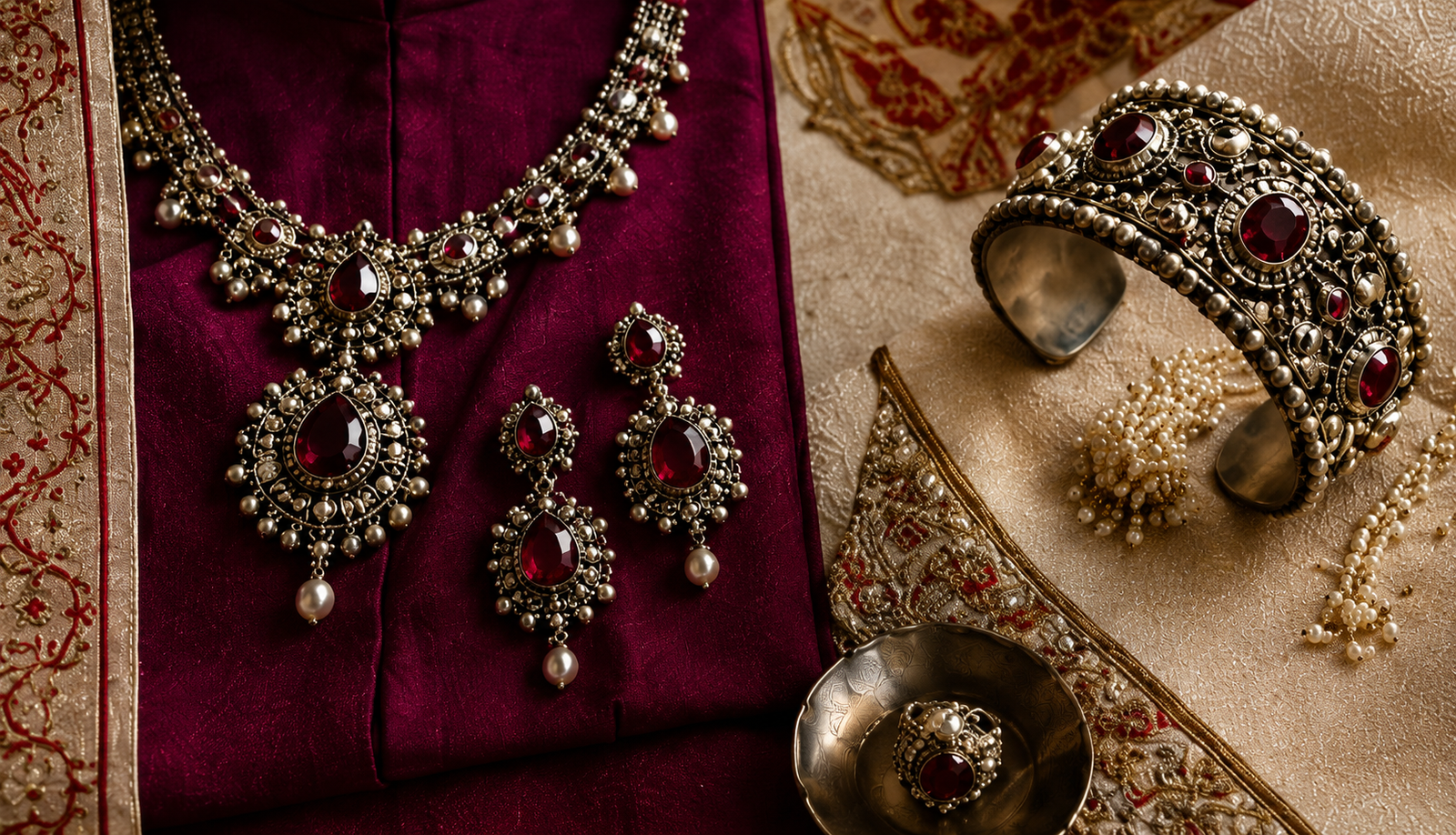
Court jewellery was never meant to sit still in a vault. The Begums of Tonk wore their finest pieces to move in — to dance, to receive guests, to sit for a portrait with a restless child on one hip — and the Nawabs were, if anything, less restrained still: a well-dressed nobleman thought nothing of a triple string of pearls, a jewelled turban ornament, and rings on more fingers than we would consider polite today. Grandeur was never this family's women-only inheritance, and we see no reason to treat it as one now.
Here are five ways we like to see heirloom-inspired pieces find their way back into daily life.
Wear the statement piece down, not up.
A carved silver collar or heavy chandelier earrings need less occasion than you think. Set against a plain white shirt or simple kurta, the contrast does the work — the piece reads as chosen, not costumed.
Let one piece speak for the whole outfit.
Court dressing understood restraint as well as excess. If the earrings are speaking, let the rest of the look stay quiet — one confident piece outperforms three competing for attention.
Bring the grandeur to the collar and the hand — for men, too.
A turban ornament was, at heart, a brooch. Worn today on a bandhgala lapel, or reimagined as a single substantial chain, that same vocabulary sits naturally on a modern man's wardrobe — and we are increasingly asked to reinterpret old sarpech and necklace motifs exactly this way.
Mix eras on purpose.
An antique-finish silver cuff looks more interesting against contemporary tailoring or plain denim. Heritage jewellery does not ask for period costume — only for one era to speak clearly against another.
Think in generations, not seasons.
Choose pieces flexible enough to be worn again by someone else entirely — a daughter, a son, a grandchild, in a decade whose fashions we cannot yet guess. That has always been the real test of a court jewel.
None of this asks anyone to dress like a courtier. It only asks that jewellery be treated the way it always was in this family — worn, borrowed, handed down, and worn again, rather than kept for an occasion that never arrives. We have always believed real luxury is not the price of a piece but its ability to outlast a single owner, a single decade, even a single gender's wardrobe — to carry a family forward, one wearer at a time.