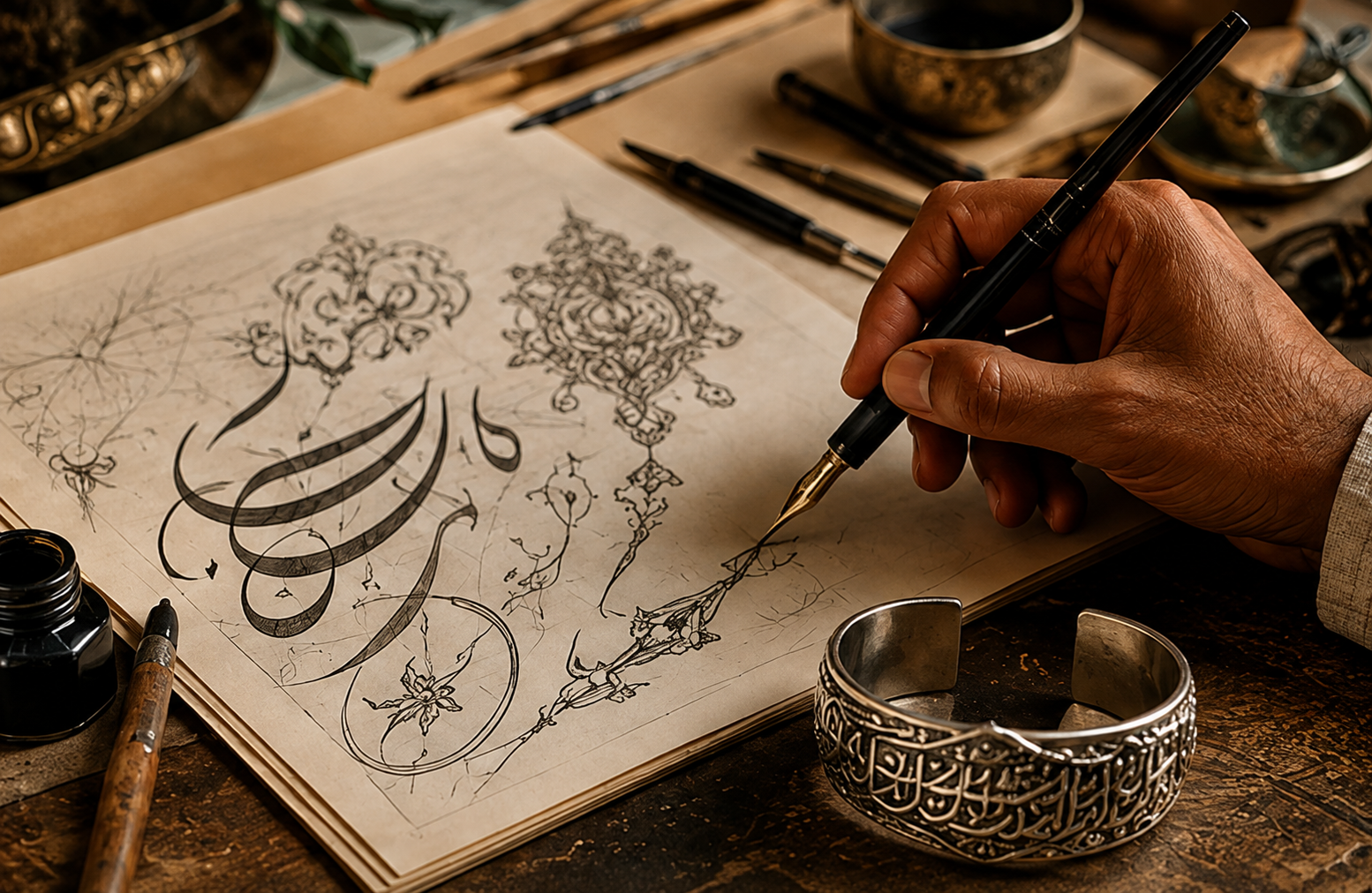
Tonk has always kept close company with the written word. In the time of the Nawabs, the state built one of the finest libraries of Arabic and Persian manuscripts in northern India — a collection so extensive it now forms the heart of a dedicated research institute in the city, home among its treasures to one of the largest handwritten copies of the Quran Sharif anywhere in the country. Scholars still travel from across the world to study its pages of nastaliq and naskh script, each letter drawn by a hand as trained as any goldsmith's.
That regard for calligraphy, or khattati as it is known here, was never treated as something to be studied behind glass. The family has long lent its name to keeping the art alive among the young — a small competition held in the city most winters, open to students keen to try their hand at the reed pen, judged as much on the confidence of a stroke as on its correctness. Some of these young calligraphers go on to study the script seriously; a few, we have found, drift naturally toward design instead, because the two disciplines ask for the same patience, and the same eye for where a line should swell and where it should taper away to nothing.
It is this second group we have come to lean on. A calligrapher trained to shape the sweeping tail of one letter, or the deep, generous bowl of another, already understands — better than most — how a curve should move. That understanding translates with surprising ease from ink to silver. Look closely at the flowing line that runs the length of one of our cuffs, and you may be looking at the ghost of a calligraphic stroke: the same rise and fall, the same unbroken confidence, only frozen now in metal instead of drying on paper.
We are fond of this connection for what it says about where design can come from. It asks for no new vocabulary of ornament — only a willingness to look at an old one differently. A city that has spent two centuries training the hand to write beautifully has, without quite meaning to, been training it to design beautifully as well. Every cuff, pendant or ring that begins its life as a calligrapher's stroke carries a little of that inheritance forward — proof that in Tonk, the pen and the piercing saw have always been closer relatives than they first appear.