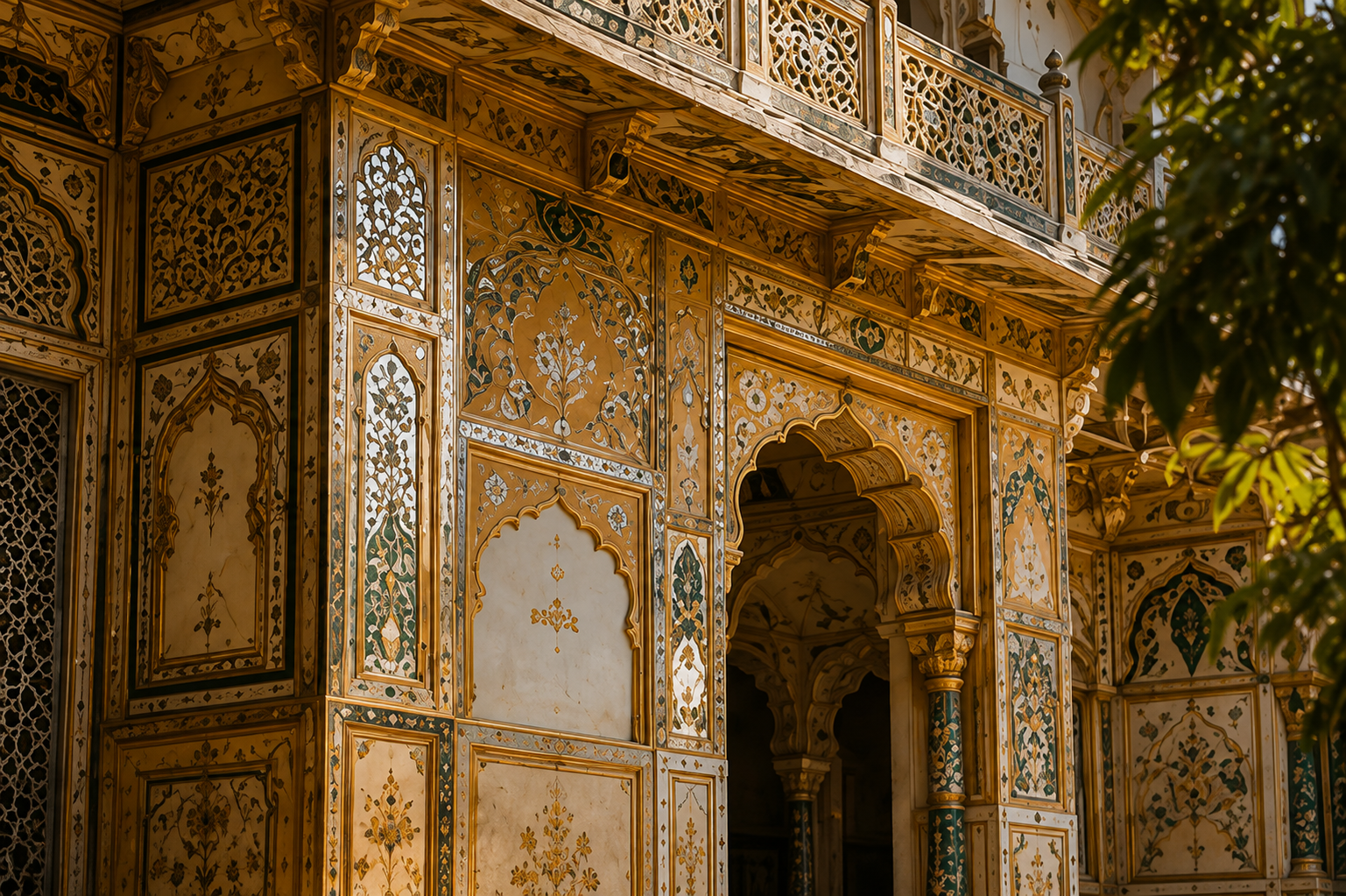
Ask anyone in Tonk for directions to the Sunehri Kothi and they will point you toward the old palace quarter without needing to think. The Mansion of Gold has stood there since the early nineteenth century, begun in the time of the state's founding Nawab and completed under the fourth Nawab, Ibrahim Ali Khan, who wanted a hall grand enough for an evening of poetry, music and dance among his court.
He got more than a hall. What rose was a chamber where nearly every wall and ceiling is worked in mirror mosaic, gilding and painted glass, lit through stained panes said to have travelled from as far as Belgium — a room that does not merely display gold and silver but seems built from them, catching the smallest flame and returning it a hundredfold. Visitors have long said that stepping inside feels less like entering a building than stepping inside a piece of jewellery grown to the size of a room.
Members of the family still recall being taken to sit beneath its mirrored ceiling as children, tipping their heads back until the hundred small reflections of a single lamp blurred into a field of stars — an image more than one of us has since asked our karigars, half joking, to try and set into silver.
Family lore holds that Ibrahim Ali Khan insisted local hands be trained in the work too, not brought in from outside Tonk alone, so the skill would remain in the city long after the last panel was set. True or not, the mirror-work of Tonk did outlive him, and its patterns — radiating stars, small foiled facets, painted borders of running vine — have stayed part of the city's visual memory ever since.
It is this memory our design table returns to most often. Long before a new collection reaches the bench in Jaipur, it usually begins with a photograph or sketch of some corner of the Sunehri Kothi — the way a mirror star breaks into eight radiating points, or the way a painted border repeats a single leaf until it becomes rhythm rather than decoration. A necklace's central medallion may owe its setting to a ceiling panel most of our clients will never see in person; a bracelet's repeating link may be a lattice border, translated from painted glass into cast silver.
The Kothi itself cannot be moved from Tonk, and most of the world will never walk beneath its mirrored ceiling. But something of its particular, glinting opulence can still travel — worked in miniature, into a pendant or a pair of earrings — outward from Tonk into wardrobes it was never built to reach directly. That, to us, is the quiet purpose of a heritage house: not to keep the golden mansion behind glass, but to keep finding new ways to let it shine.