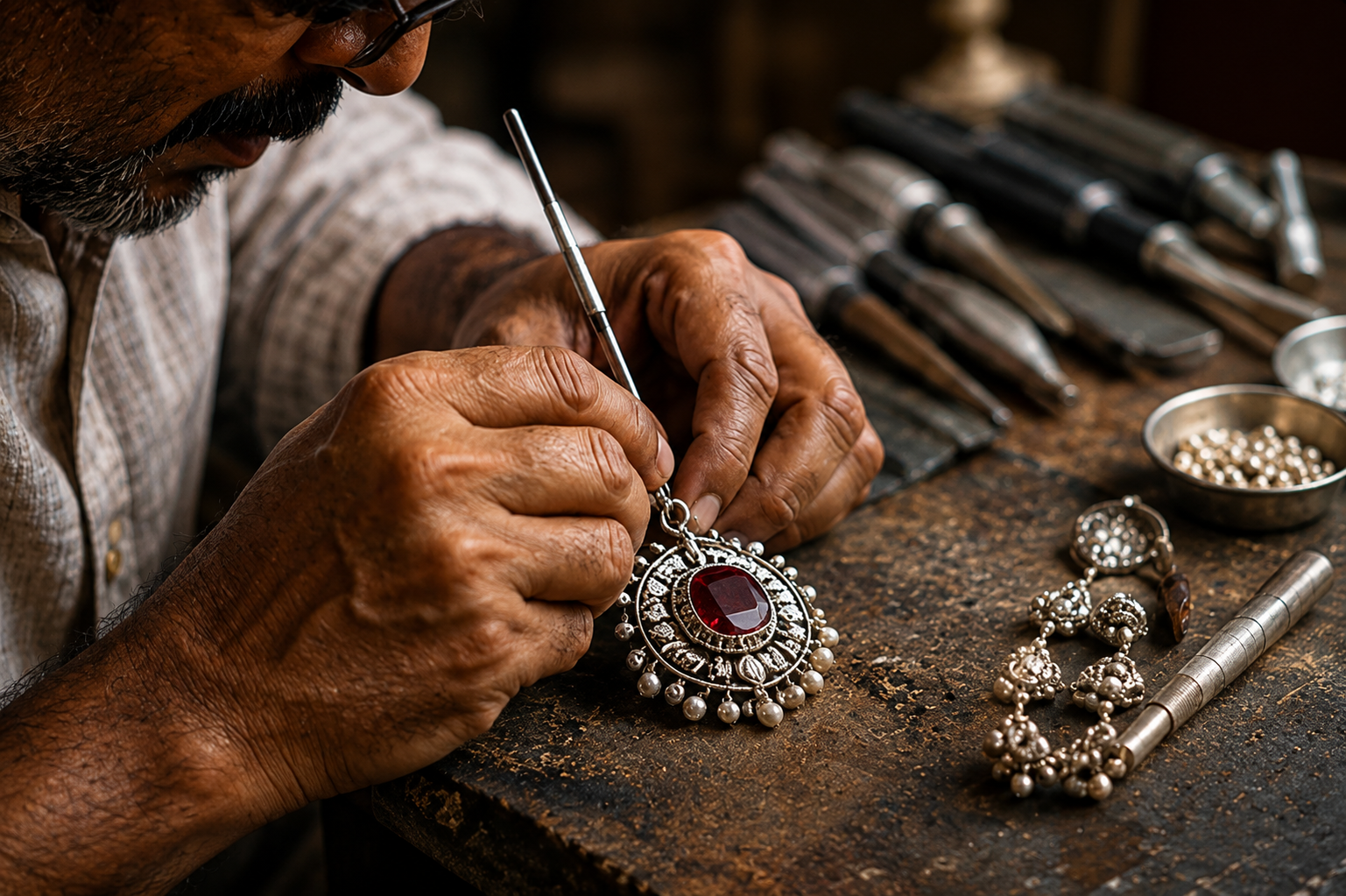
Long before the rest of Jaipur stirs, the atelier is already awake. A single light hums low over the workbench, the smell of beeswax and warmed metal hangs in the air, and somewhere near the window a craftsman sits bent over a sheet of silver no larger than his palm, a fine saw moving through it as unhurriedly as breath.
He will tell you, if you ask, that his grandfather sat at a bench much like this one, and his grandfather's father before him — that the family has been coaxing silver into flowers, leaves and lattice since the days when Rajasthan's courts, Tonk's among them, kept karigars on retainer the way they kept musicians and calligraphers. The skill was never written down. It travelled the only way such things can: from an elder's hand to a younger one, over years of watching before touching, and touching before being trusted with anything that mattered.
To make one pendant, the day begins with a drawing — often just a pencil outline taken from an old lattice screen, or a piece of court jewellery remembered rather than photographed. That outline is pasted onto sterling silver, and the piercing saw follows every curve by eye and hand alone, freeing the design one careful stroke at a time. What remains is coaxed into shape with a family of small hammers, each barely larger than a fingertip, until a flat sheet holds the dome and curve of a finished ornament.
Then comes the setting — the slowest part of all. Each gemstone is seated into its own hand-raised bezel, one prong closed at a time, so an elaborate piece may ask for several hundred such small decisions before it is done. A wrong angle, a moment's impatience, and a stone sits crooked forever; so the artisan does not hurry. Afterwards the silver is oxidised in careful measure, darkening the recesses so the carving reads in light and shadow, before it is polished by hand to a depth no machine finish quite replicates.
It is not unusual for a single elaborate pendant, or a pair of chandelier earrings, to occupy a bench for two or three weeks — not because the work is slow, but because it refuses to be rushed. A hundred small decisions, made correctly, take exactly the time they take.
This is why Ameer of Tonk works as we do — through the same artisan families whose names have been tied to silver for generations, first in service to Rajasthan's courts, and now to us. When a piece leaves the atelier, it carries two inheritances at once: the design language of old Tonk, and the living, unbroken craft of Jaipur's hands. We think that is worth the weeks it takes.